
The global travel industry is entering a new chapter.
After several years of disruption, rapid recovery and changing consumer behaviour, tourism is evolving from a volume-driven industry into one increasingly defined by experience, personalisation, connectivity and value.
For travellers, the question is no longer simply where to go. It is how to travel, what to experience and how a journey can create lasting memories.
This transformation is particularly visible in the luxury travel sector, where affluent travellers are increasingly prioritising privacy, wellness, gastronomy, culture, exceptional hospitality and access to experiences that cannot easily be replicated elsewhere.
At the centre of this evolution is the Middle East.
Dubai, Abu Dhabi, Riyadh, Jeddah, Doha and other regional destinations are increasingly positioning themselves not only as gateways between continents, but as destinations in their own right.
The Middle East is becoming one of the most dynamic centres of global tourism development, supported by major investments in aviation, hospitality, culture, entertainment, sports and destination infrastructure.
According to recent research from Resonance, the Middle East and North Africa is currently the only major global region where tourist arrivals are more than 20% above 2019 levels, highlighting the region’s growing importance in international luxury travel.
The question for the industry is no longer whether the Middle East will play a major role in global tourism.
It is how significant that role will become.
A new definition of luxury
Luxury travel is changing.
For decades, luxury was strongly associated with five-star hotels, first-class aviation, private transfers and exclusive restaurants.
These remain important, but today’s affluent traveller is increasingly looking for something more difficult to define: meaning.
A luxury journey might involve a private villa in the Mediterranean, a remote desert experience in Saudi Arabia, a wellness retreat in Asia, a private yacht in the Gulf or an exclusive cultural experience that gives travellers access to places and people normally unavailable to the general public.
This shift is sometimes described as the movement from material luxury to experiential luxury.
The traveller is willing to spend more, but expects that spending to produce something genuinely memorable.
Recent research from Virtuoso points in the same direction. Its 2027 Luxe Report, based on more than 3,100 travel advisers across more than 50 countries, indicates that affluent travellers continue to prioritise meaningful experiences, quality, access and time.
Celebration travel, privacy and all-inclusive luxury experiences are among the areas expected to remain particularly strong.
For hotels, airlines, cruise companies and destinations, this represents an important change.
The product is no longer simply the room, the seat or the destination.
The product is the entire journey.
The Middle East’s growing influence
Few regions illustrate this transformation more clearly than the Middle East.
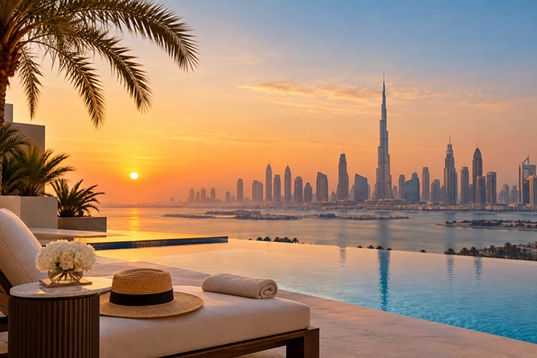
Dubai has already established itself as a global luxury destination, combining international aviation, hospitality, retail, gastronomy, business and entertainment.
But the next phase of regional tourism is considerably broader.
Saudi Arabia is developing new destinations and tourism experiences at an unprecedented scale. Riyadh is becoming increasingly important for business, entertainment, culture and gastronomy, while destinations along the Red Sea are introducing a new model of high-end coastal tourism.
Abu Dhabi continues to develop its cultural and luxury tourism proposition, while Qatar has strengthened its position through major sporting, cultural and hospitality investments.
Oman offers a different proposition, built around nature, mountains, coastline, heritage and low-density luxury.
The result is a Middle East tourism market with increasingly diverse destinations.
The region is no longer selling simply sunshine and luxury hotels.
It is selling culture, adventure, architecture, wellness, sport, gastronomy, shopping, entertainment and access.
Deloitte’s 2026 Travel Insight Report describes the Middle East as entering a new era of tourism in which the competitive advantage will increasingly depend on experience design, digital trust, sustainability and the ability to turn visitors into long-term advocates.
That represents a significant evolution.
From stopover to destination
For many years, the Middle East’s geographical position made it one of the world’s most important aviation hubs.
Dubai, Doha and Abu Dhabi became natural connecting points between Europe, Asia, Africa and the Americas.
But the region is increasingly moving beyond the concept of the stopover.
Travellers are now choosing to stay.
This is a crucial development.
A passenger who once spent 24 hours in Dubai between two flights may now stay for several days, combine business with leisure, explore the city’s restaurants and cultural attractions, or use the destination as the starting point for a wider regional journey.
The same evolution is taking place elsewhere in the Gulf.
Air connectivity gives the region an enormous strategic advantage, while new hotels, attractions and destinations are giving travellers more reasons to extend their stay.
The hotel becomes part of the destination
The role of the hotel is changing alongside the traveller.
In the past, hotels were primarily accommodation providers.
Today, the best properties increasingly operate as destinations themselves.
Restaurants, rooftop venues, spas, private beaches, art programmes, wellness facilities and curated experiences can all influence where travellers choose to stay.
This trend is particularly visible in the Middle East, where hotel developments are increasingly integrated into larger destination projects.
Hilton’s 2027 global travel research, based on more than 14,000 travellers across 14 markets including the UAE and Saudi Arabia, found that 36% of UAE travellers and 41% of Saudi travellers ranked staying in a great hotel among the top three indicators of a successful trip.
The finding illustrates how accommodation is becoming part of the experience rather than simply a place to sleep.
For luxury hotels, this creates a powerful opportunity.
A successful property can become a reason to travel to a destination in itself.
The rise of intentional travel
Another important trend is the desire for more meaningful and flexible travel.
Travellers are increasingly questioning the idea that a successful holiday needs to be perfectly planned.
Instead, there is growing interest in flexibility, discovery and personal wellbeing.
Hilton’s research identifies this as a major trend for 2027, describing a movement away from the pressure to create the “perfect trip” and towards more flexible and intentional experiences.
This does not necessarily mean less luxury.
In fact, it may mean a different type of luxury.
The ability to change plans.
The ability to stay longer.
The ability to travel privately.
The ability to decide what to do each day rather than follow a rigid itinerary.
Time itself is becoming a luxury.
Wellness moves to the centre
Wellness is another defining element of the new travel landscape.
Luxury travellers increasingly want holidays that improve their wellbeing rather than simply provide an escape.
This has encouraged hotels and resorts to invest in fitness, sleep programmes, nutrition, spa treatments, medical wellness, nature-based experiences and mental wellbeing.
The Middle East has significant potential in this area.
Large-scale resorts can combine privacy, climate, nature and high-end hospitality to create new wellness destinations.
Saudi Arabia’s Red Sea developments are particularly interesting because they combine luxury hospitality with natural landscapes and low-density tourism.
Meanwhile, established destinations such as Dubai can integrate wellness into an urban luxury experience.
Technology and the human touch
Artificial intelligence is also transforming the travel industry.
AI can help travellers discover destinations, compare hotels, generate itineraries and receive personalised recommendations.
Yet the rise of AI is not eliminating the importance of human expertise.
In fact, the opposite may be happening.
Hilton’s 2027 research found that while 63% of global travellers trust AI to inspire their next holiday, only 22% trust it more to build a complete itinerary. Personal recommendations remain highly influential.
This suggests that the future of travel will be hybrid.
Technology will handle research, data and personalisation, while experienced travel professionals will continue to provide judgement, access and reassurance.
For luxury travellers, this human element is particularly important.
A computer can suggest a hotel.
A trusted adviser can know which room to request, which restaurant deserves a reservation, which yacht operator is reliable and which private experience is genuinely worthwhile.
The next generation of global destinations
The geography of luxury travel is also evolving.
Traditional destinations such as Paris, London, New York, Rome and the Maldives remain highly attractive.
But travellers are increasingly looking for new destinations.
The Middle East is one of the strongest examples.
Egypt is investing heavily in new coastal developments and cultural tourism. Saudi Arabia is developing new destinations across its coastline and interior. The Gulf continues to invest in hospitality, aviation and entertainment.
North Africa and the wider Mediterranean are also benefiting from this shift.
This diversification could become one of the defining characteristics of luxury travel in the coming years.
Travellers want the iconic destinations, but they also want to be among the first to discover what comes next.
Sustainability and responsibility
Luxury travel is also facing a more fundamental question: how can growth remain sustainable?
Travellers are increasingly interested in environmental impact, local communities, biodiversity and responsible development.
For destinations, sustainability is therefore becoming a competitive issue rather than simply a corporate responsibility topic.
The future of luxury tourism will increasingly depend on balancing exclusivity with environmental responsibility.
Low-density resorts, renewable energy, water management, local sourcing and protection of natural environments can become part of the luxury proposition itself.
In this context, the Middle East has an opportunity to develop a new model of tourism rather than simply reproduce established models.
A new era for global travel
The global travel industry is clearly entering a period of transformation.
The traveller of the future will be more informed, more connected and increasingly selective.
Luxury will be measured less by the number of stars and more by the quality of the experience.
Technology will make travel easier to organise, but trusted human relationships will remain essential.
Hotels will become destinations.
Airports will become gateways to experiences rather than simply transit points.
And emerging markets will compete with traditional tourism capitals for the attention of international travellers.
For the Middle East, the opportunity is particularly significant.
The region combines geographical connectivity, investment capacity, ambitious tourism strategies, world-class aviation infrastructure and a rapidly expanding hospitality sector.
Dubai has already demonstrated what is possible.
The next chapter will be defined by Saudi Arabia, Abu Dhabi, Qatar, Oman and a new generation of destinations across the region.
The global travel map is changing.
And as travellers increasingly search for experiences that combine luxury, authenticity, wellbeing and discovery, the Middle East is moving from being a bridge between destinations to becoming one of the world’s most important destinations itself.
The future of travel will not simply be about going further.
It will be about travelling better, experiencing more deeply and discovering destinations that offer something genuinely different.
For the global travel industry, that future is already beginning.


